Camping at Winchester Speedway: A Championship, a 400, and a Weekend Living at the Track
Biography Photography
Some race weekends are just good. Others are the kind you’ll be talking about for years. As a motorsport photographer, this was one of those weekends: I pitched a tent at Winchester Speedway in Indiana, got hired by Late Model and Modified drivers and teams all weekend long, ran cameras from the infield to inside the cars, and photographed a championship getting clinched at a historic night race.
Packing My Motorsport Photography Kit for a Weekend at the Track
When you're living at the track for a weekend, packing is half the battle. I split my gear into two categories: what I need to work, and what I need to survive.
The work kit. My professional camera body was the main workhorse, but I also brought a film camera because some moments deserve a different treatment. I kept it to myself until now that I still have film to develop from 2025's Winchester weekend. I brought a set of action cameras so I could mount them in cars and get the driver's-eye view. And since my business lives and dies on speed, I packed a full editing setup: a computer and my phone that’s always ready to cull, edit, and deliver images between sessions.
The survival kit. A big tent, a comfortable bed (I'm a photographer, not a masochist), an editing setup, portable power, and food and snacks. I'll come back to that last one.
As for who I was working for, that was the best part: multiple teams and drivers across the Late Model and Modified classes throughout the weekend. Nobody's weekend is the same, so mine wasn't either. Between client work, I planned to photograph people I'd like to work with in the future, because the best portfolio pitch is a gallery of their car in action.
Preparing for the Problems
Camping at a racetrack sounds romantic until you list what can go wrong. I had three major concerns going in.
Power. There were no hookups. Every camera battery, phone, laptop, and light would run off portable battery setups that had to recharge the batteries that, in turn, recharged everything else, and light the campsite at night too. It's a power-management challenge with real consequences if you lose.
Weather. Tropical storms churned in the south and were heading our way, and I was sleeping in a tent. Enough said.
Internet. Winchester Speedway sits in a field in Indiana. Cell service was just strong enough to upload the essentials, and nothing beyond that. For someone whose workflow includes delivering edited images on the fly, that's a real limitation.
Arrival: The Plan Changes Immediately
I hadn't been on the property long when I learned that the weekend's plan changed completely: Winchester was going to become a night race, the first time in it's 55 years of running. That meant a compressed, rearranged schedule, and a much denser weekend than I'd prepared for. The internet would get me what I needed to get done, done, and nothing more, so efficiency was the game.
And about that food: I packed a propane camp stove set up. But if you bring the wrong stem to connect your stove to your fuel, you're out of luck. Realizing I literally couldn't cook, I made a new meal plan and pushed forward.
Day One: Race Day Photography and Same-Day Delivery
I kicked off Friday by meeting my teams, confirming what they needed from me, and nailing down schedules. From there, I went back and forth and around the half-mile track, photographing clients between the Late Model and Modified practice sessions.
The 14 garage was tense until qualifying wrapped up, and with good reason: a lot was on the line. As the day went on, more clients walked up and hired me on the spot for motorsport photography and video work. That's one of the quiet perks of being embedded at the track. You're visible, you're working, and the people who see the work can ask for it right then.
The real key to Friday was speed. Between sessions, I culled, edited, and delivered same-day race photos, using apps on my phone to get images to people almost as fast as I could take them. Immediately after qualifying, the 14 team curated and edited the day's images. Here’s how I deliver images in near-real time.
Winchester 100 Photos: Chase Pinsonneault Clinches the Championship
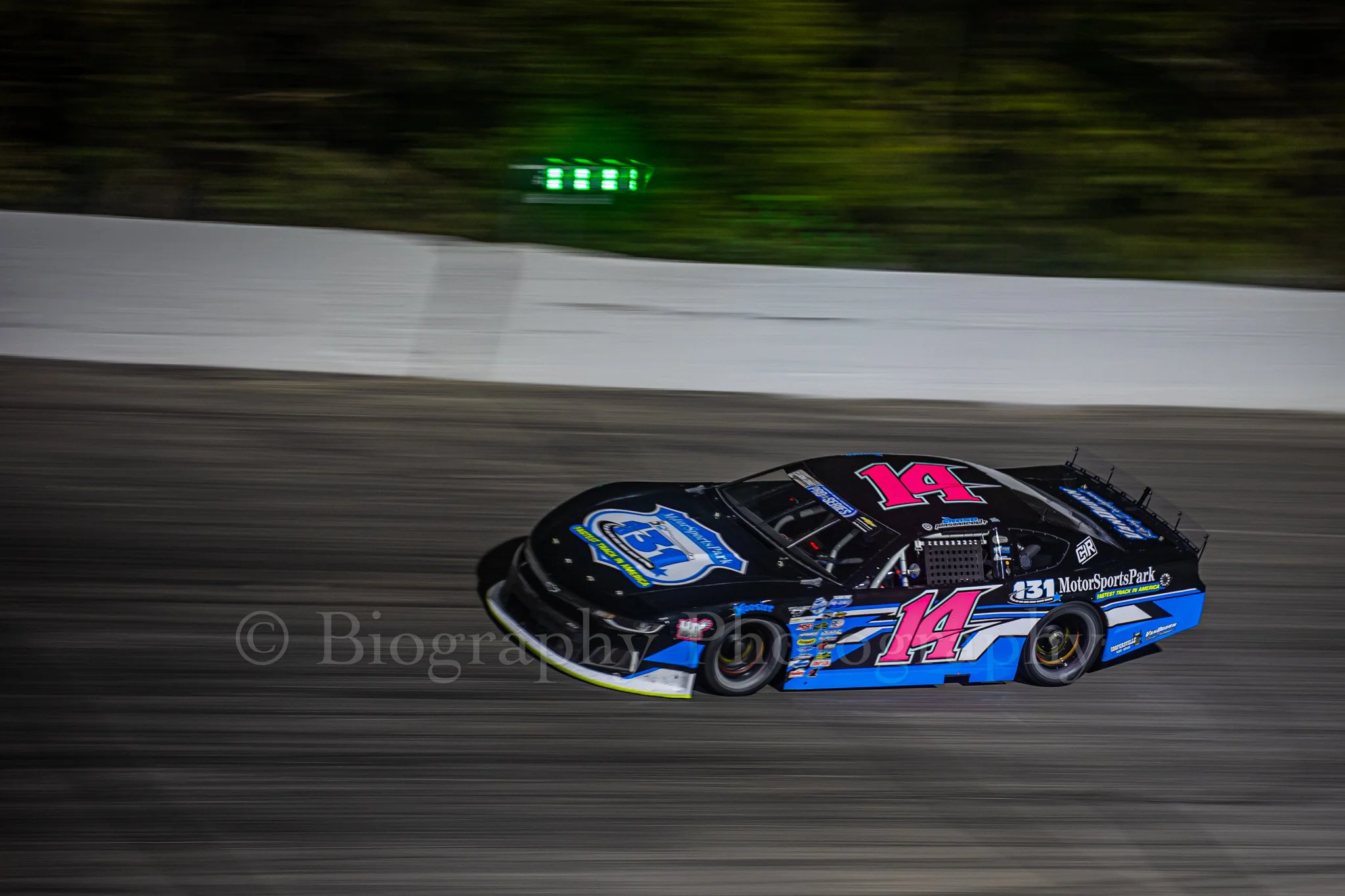
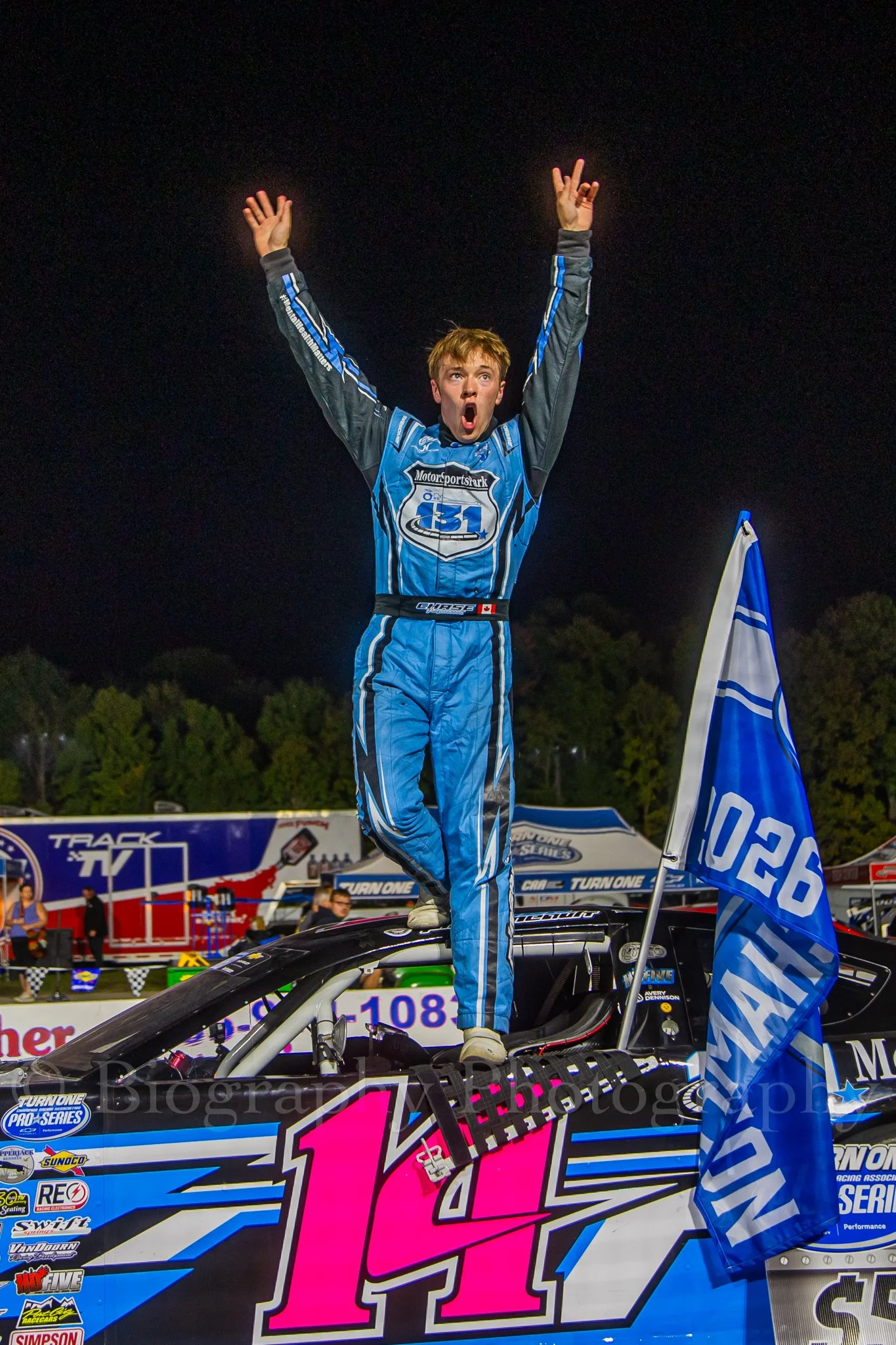
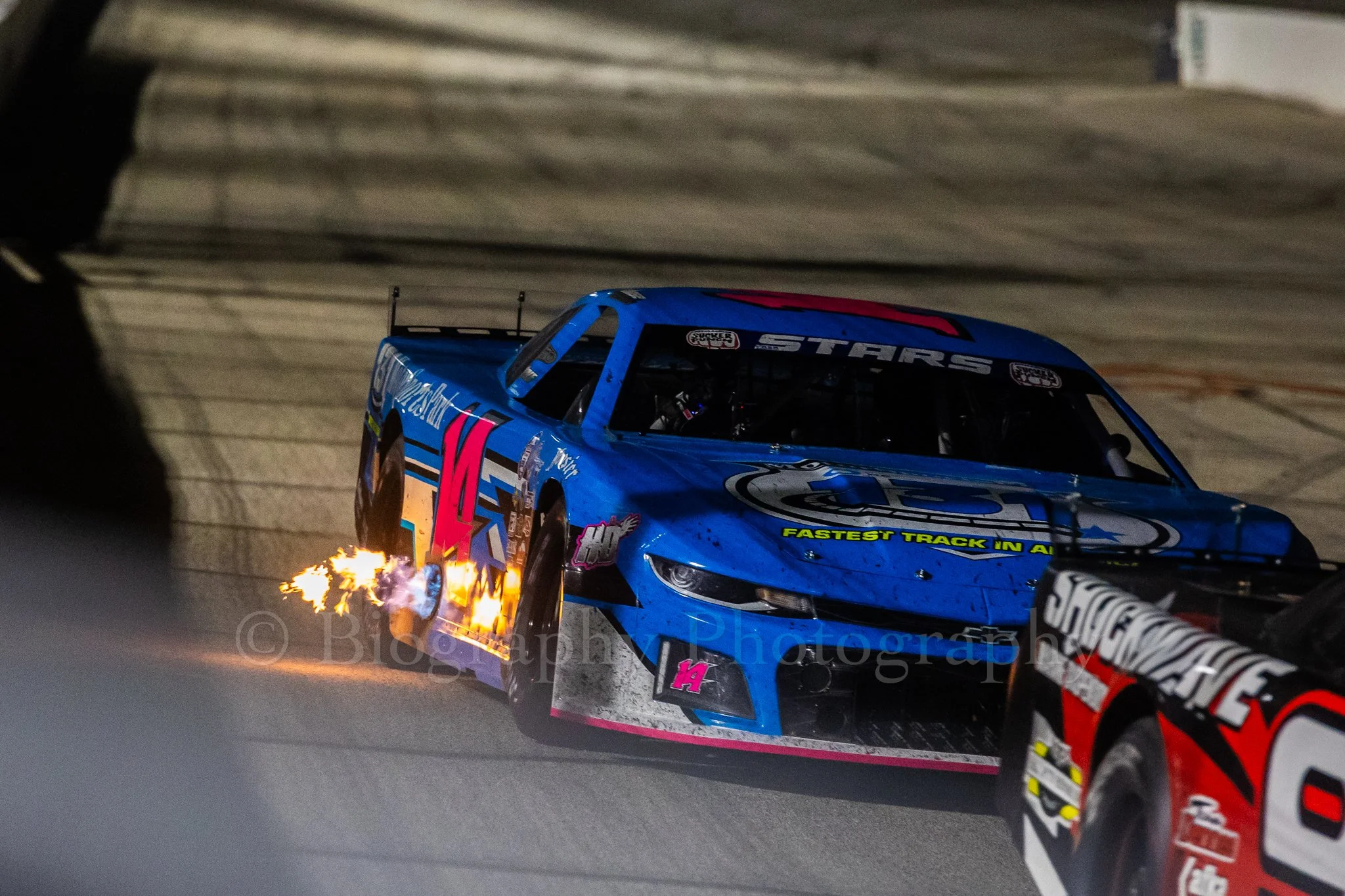
Friday night was the Winchester 100, and I was working with late model driver Chase Pinsonneault.
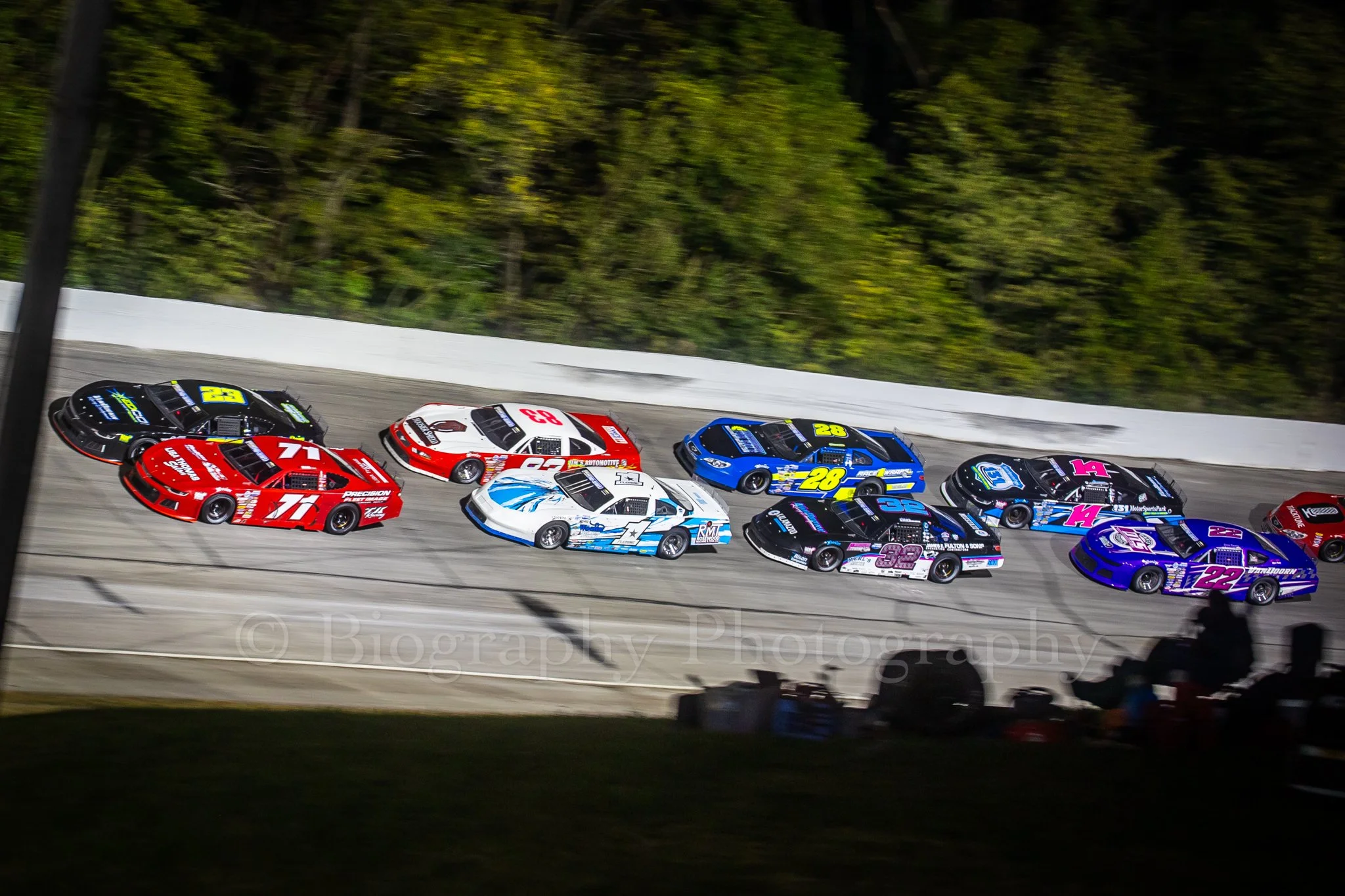
Chase entered the race needing only the green flag to clinch the Turn One CRA Pro Series season championship. He didn't treat it like a formality. He ran up front the entire race, shuffling around the top four, fighting for the win, and ultimately finished second. That result confirmed the title, and that meant post-race celebrations for all of us.
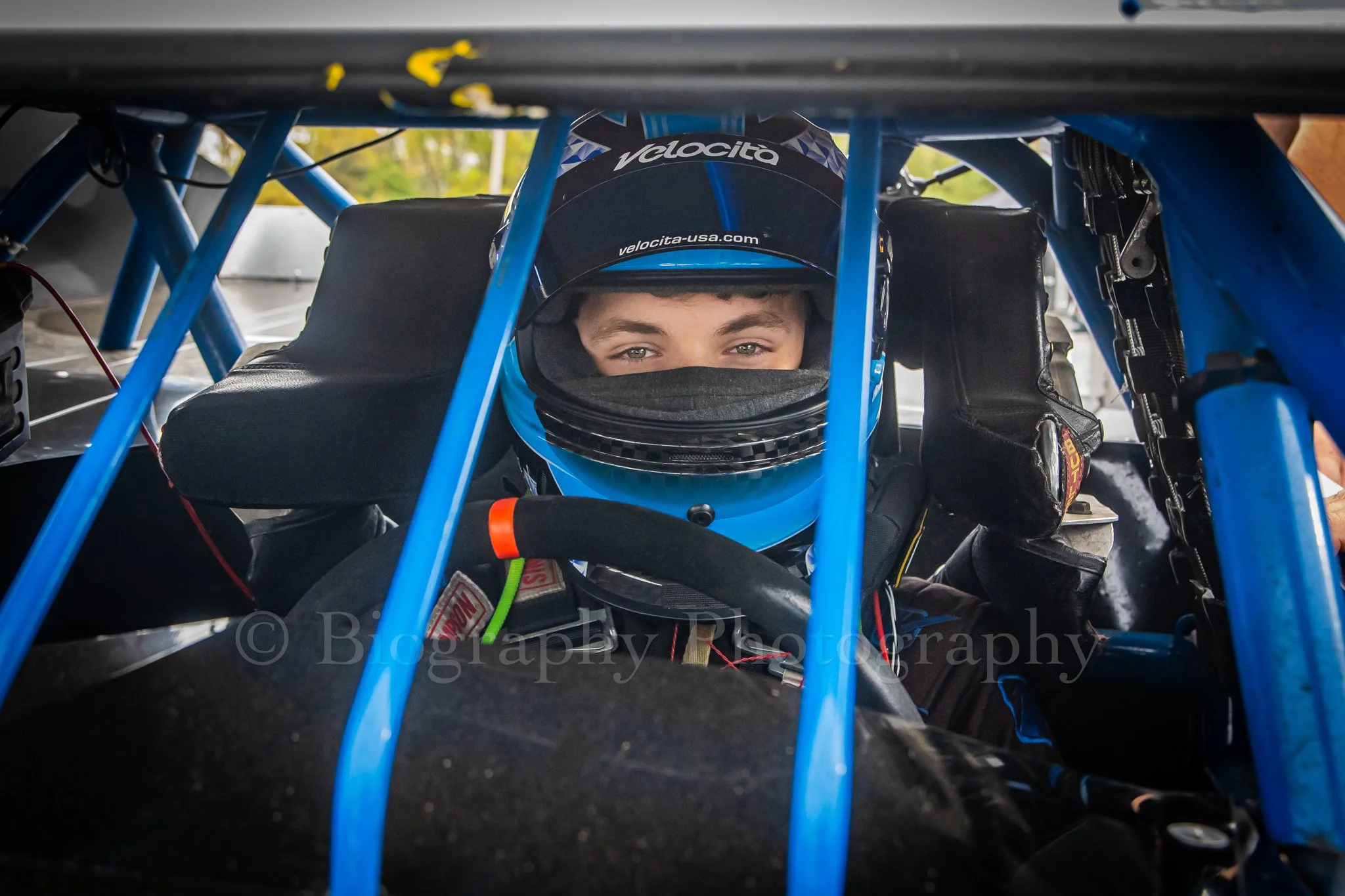
The night ended in my tent with editing and backing up everything: images and footage from my in-car 360 cameras during modified practice and from riding along with Chloe Mazzagatti in the Winchester 100. Going through the images is where I realized my night race photography game had really stepped up. CHECK OUT THE VIDEO HERE
I don't take being trusted to photograph championship moments lightly. Being in this position for the second year in a row, and with a different team than last year, is incredible. Full Winchester 100 blog post
Day Two: Modified Racing Photography with Carson Klingelhofer
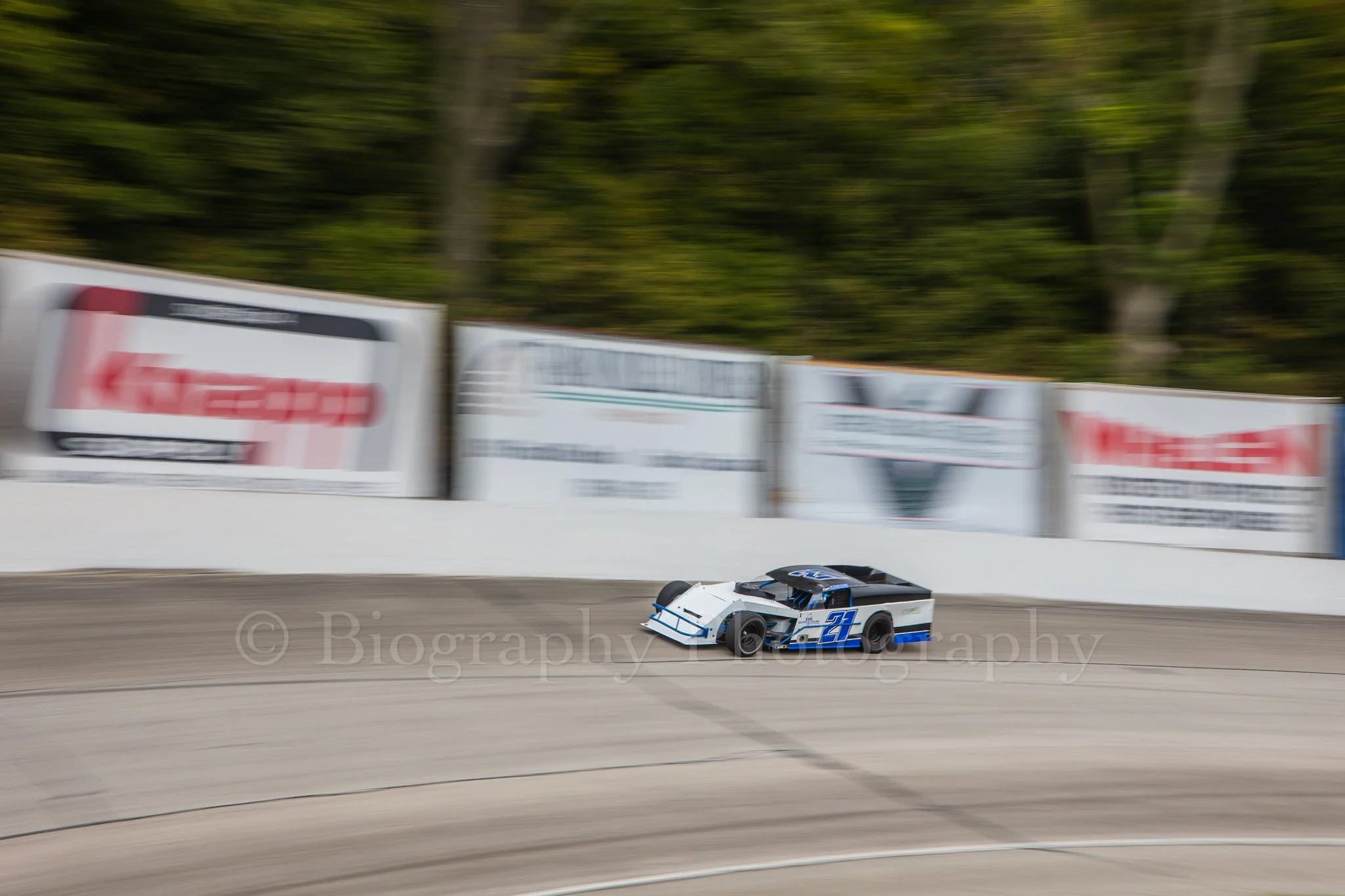
Saturday started early (for a race day), with cars on track at 10:30, starting with my modified driver, Carson Klingelhofer. He would be racing in the Run for the Gun 40 later in the day. The new schedule squeezed practices, qualifying, and races closer together, and the day's pace quickly became like a strong river current. You don't swim against it. You stay upright and keep moving.
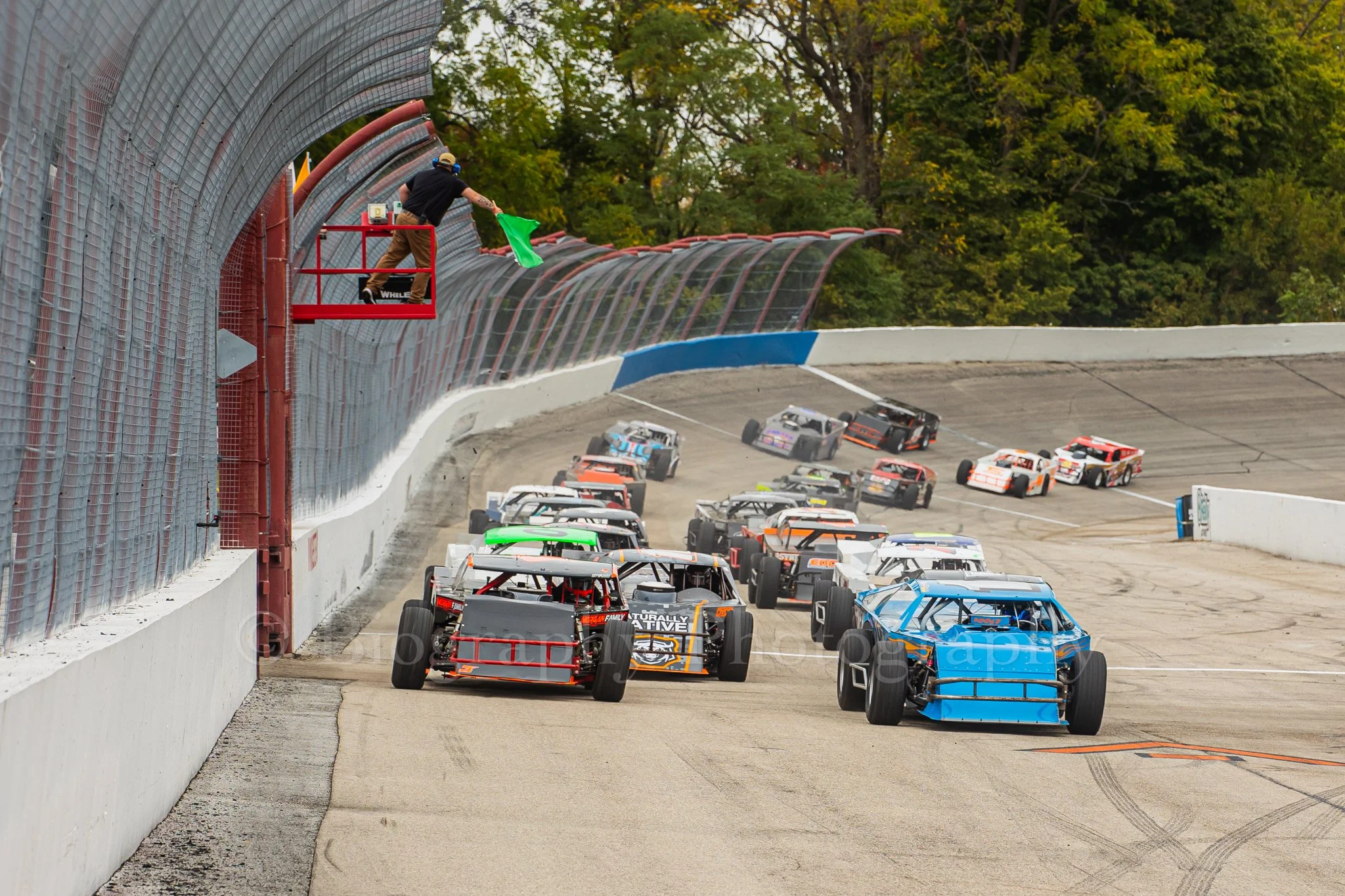
Carson Klingelhofer qualified 18th for the Modifieds Run for the Gun 40. Overall, it went well; despite a few communication issues, he finished 16th. He drove like a champ, and I got some epic images of him racing around Winchester Speedway. Full Klingelhofer blog post
Photographing the Winchester 400
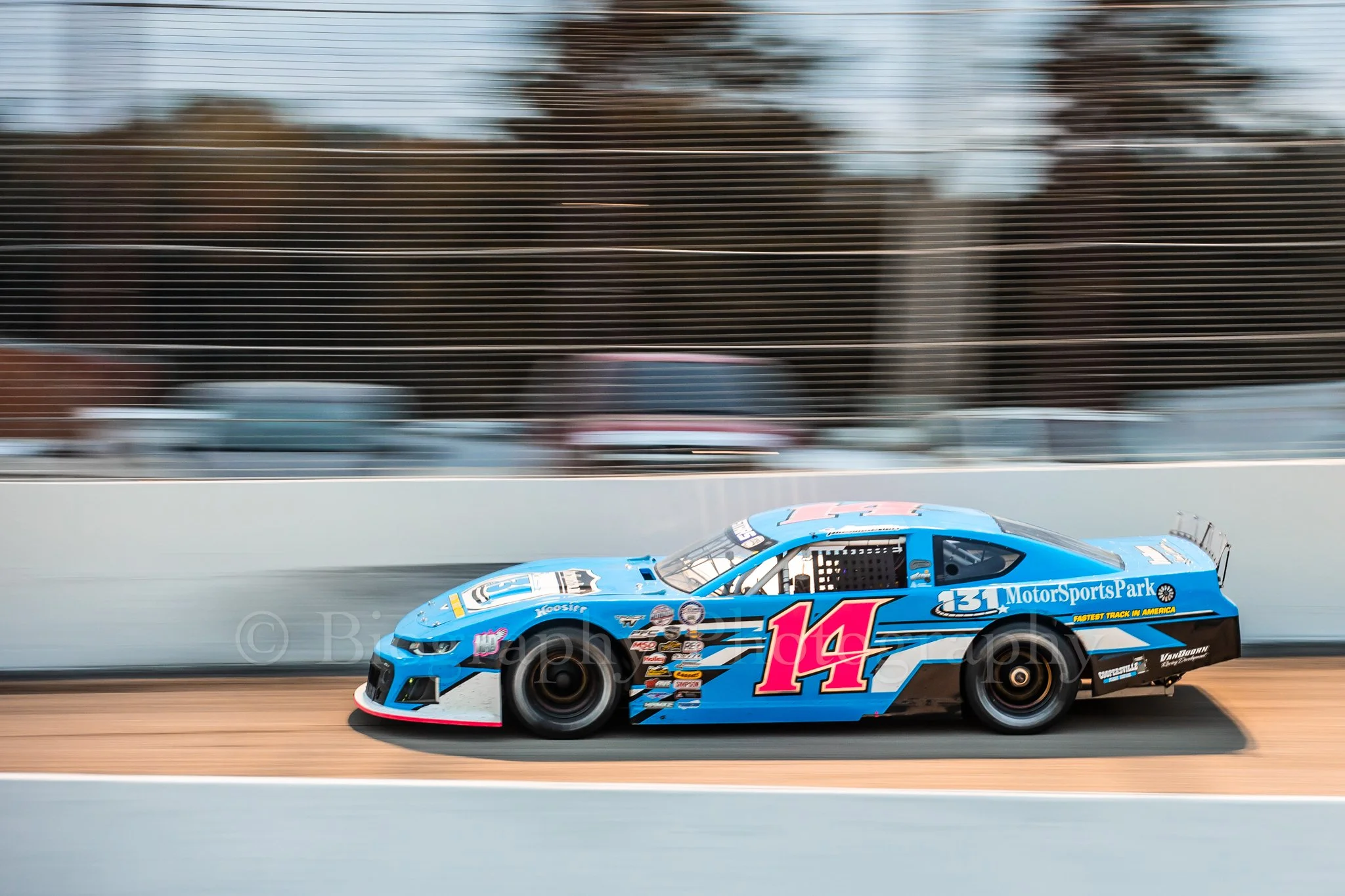
Chase's car for the Winchester 400 was a different one from the night before: a bright blue machine. After some brief practice sessions, he qualified 14th.
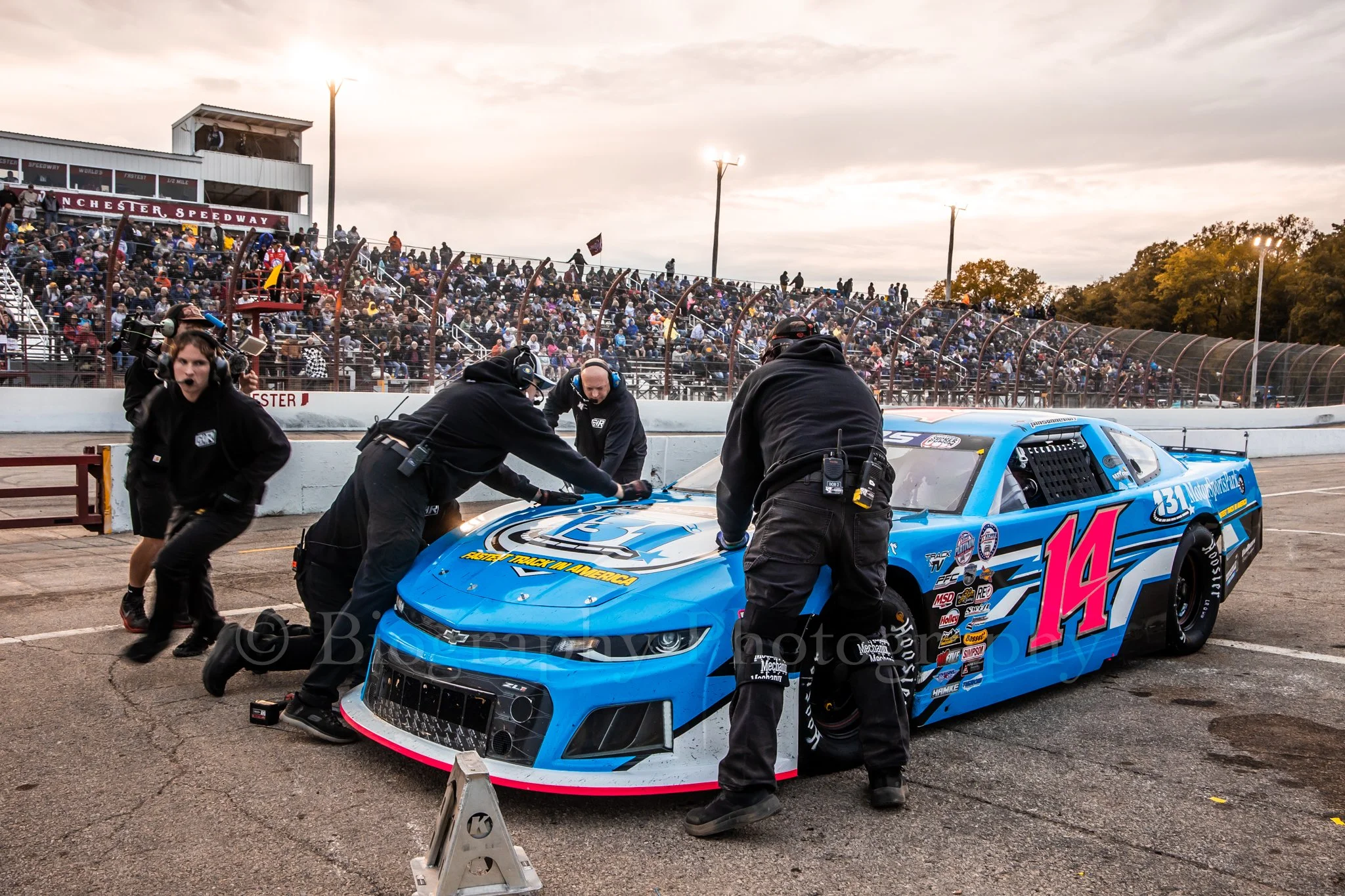
Thirty or so laps in, he was forced to pit with a right-front hub problem. What happened next proved to be a masterclass in crew work. The team took the assembly apart, diagnosed the issue, and replaced what needed replacing within minutes. The field unintentionally helped, too: only three green-flag laps were run during all that frenzy.
Chase rolled out of the pits as the field went green, only four laps down, with fresh tires and a full tank. With more than 350 laps left, the team played it semi-safe: the survival game; going fast but not in a rush. Sticking to our own plan while other cars fell out. Before long, he was back on the lead lap, fighting for positions.
He finished sixth. Considering where he'd been, that's remarkable.
I delivered images I edited throughout the day, along with images from the race itself, some only minutes old, taken immediately after the checkered flag.
Throughout the day, I photographed from some special spots, thanks to friends who trusted me enough to share their access vests. Those positions are the kind of thing money can't buy and a good reputation sometimes can. I used the acquired vest to shoot from outside the entrance to turn 1 through a photo hole, from an elevated stand further into Turn 1, and from the pit entrance.
The hectic day ended the way Friday did, with backing up images and POV videos from riding with Klingelhofer in his race, plus footage from the unique track positions and pit stops I captured on my DJI Osmo 360 camera. Then I perused the campground to walk off some of the race adrenaline, but with weather potentially inbound, I didn't find much excitement.
How the Hurdles Played Out
I'd worried about power, weather, and internet. Here's how each one went.
Power. I managed my battery situation well, even after learning on Friday that two and a half of my spare camera batteries were drained from the jump. The condensed schedule helped. On Saturday, I plugged into the team's generator setup to top off my phones and camera batteries throughout the day.
Weather. The major rain stayed away until I rolled off the property Sunday morning. It was damp when I woke up, but nothing significant rolled through despite all the threats. Mother Nature likes short-track racing; that's the only logical conclusion.
Internet. Solved on Saturday by tapping into the team's Starlink in their infield garage setup. Another incredibly helpful move.
Why Camping at the Track Made Me a Better Motorsport Photographer
Camping at Winchester Speedway was a success, and being immersed in the scene made me better at my job. It allowed me to focus more, deliver faster, and produce better work. I wasted no time getting from the track to home base, and I lost no thoughts or momentum in a car ride. And waking up and going racing a few steps away is truly something else.
These are some of the best motorsport images I've ever taken, and they should be. That's especially true of the off-track scenes: the crew, the driver, the car being worked on, and the candid moments in between. I try to make every race day the best images I've ever taken. No pressure, right? This batch felt that way. I controlled what I was shooting. I had a plan, and I followed through. I came up with new ideas and executed them, and what I saw in my mind came through in the images.
Some credit goes to my time at the dirt tracks. With less light than the pavement tracks I tend to go to, I've really built up my motorsport night photography skills. Now, my night images have become more intentional, more diverse, and more interesting. I can use my settings more thoughtfully, rather than just dropping to f/2.8 and cranking the ISO. With a heavily lit track at night, I was really able to get some great images with these developed practices.
The full gallery from my time professionally photographing for teams and drivers at the Winchester 400 is here: https://biographyphotography.pixieset.com/winchester400weekend/
Hire a Motorsport Photographer for Your Team, Series, or Track
A race only lasts a few hours. A photograph lasts forever.
The image of a driver climbing out of a car with a championship in hand will outlive every lap, every mechanical issue, and every season that follows. The photo of a crew chief kneeling in the pits at midnight, hands black with grease, is the proof that the work happened. The shot of a young driver's first championship trophy is the one that ends up on a parent's wall and a sponsor's website for a decade. You can't recreate any of it after the fact. If nobody was there to capture it, it's gone.
Motorsport images matter to everyone involved in the sport:
Drivers and teams: Sponsors want proof of value, fans want something to share, social media needs to be epic, and your race-day story deserves more than phone snapshots from the grandstands. Professional images with your car going fast, with clear logo visibility, will live on their walls forever.
Series promoters: Great images are your best marketing, with every gallery a billboard for next year's field.
Venue promoters: the people in your photos are the people who bring friends next time. A single shot of a packed grandstand at dusk can sell a greater number of tickets than any ad you could buy.
I know the stakes, because I treat every event like the one that matters most. I'll be in the garage before the green flag and in the pits after the checkers. I deliver fast, sometimes minutes after the race ends, and I look for the moments among the moments that tell the real story. I've done it in the middle of a field in Indiana, in a tent, on a battery bank and a prayer. Imagine what I can do with a little less adversity.
I offer race day photography, driver and team portraits, in-car and POV video, and sponsor content for teams, series, and venues. I always deliver content fast, with same-day delivery available.
If you want your team, your series, or your track documented at the level your racing deserves, let's talk. Email me at mike@biojpg.com and tell me about your event.
Follow along: Website | YouTube: biojpg | Facebook | Instagram | TikTok